

by Alan Dean Foster
SIGNED | First Editions | Ballantine and Del Rey | 1974-1978
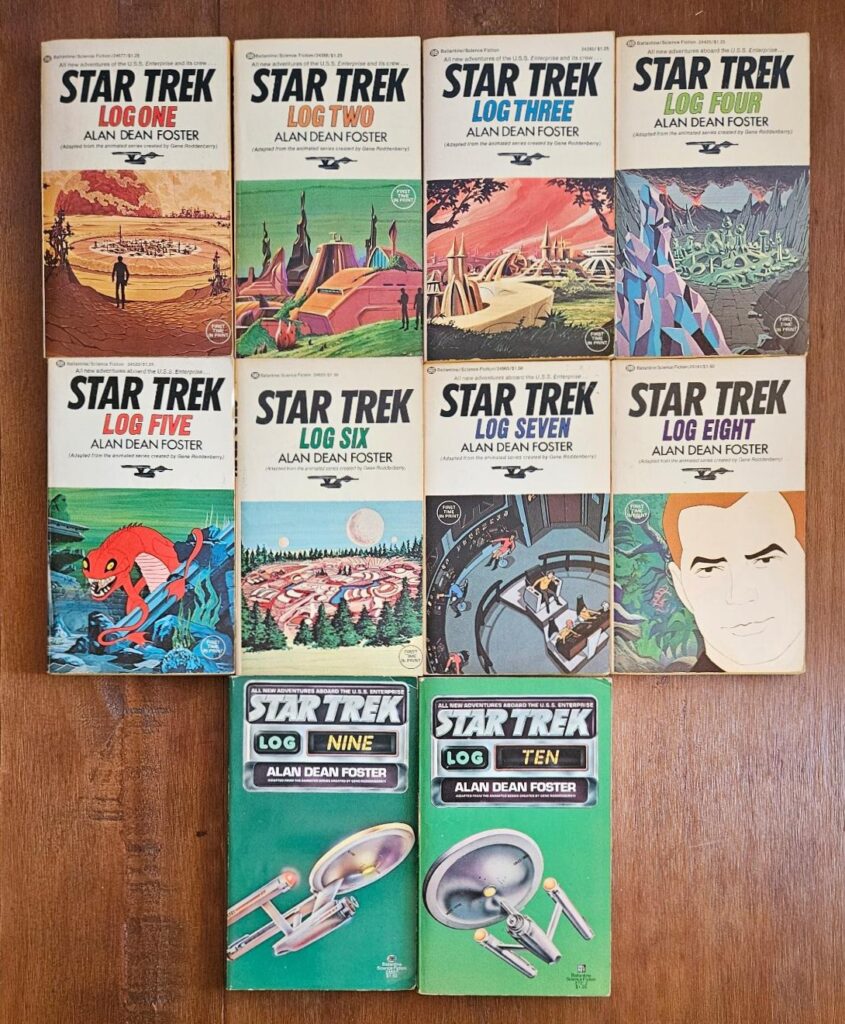
The Star Trek: Log books are the complete novelization of all 22 episodes of Star Trek: The Animated Series (colloquially referred to as TAS by fans). It is the first English-language TV series to be completely adapted into literary form. All ten books are signed by Alan Dean Foster.
The Logs have a really unusual publishing history. Which, as both a book nerd and a Trekkie, I find really interesting. Published from 1974-1978, the first six paperbacks each contain three novella-length episode adaptations, which were written as linked stories. The final four books were adaptations of individual episodes that contained original components and extended plots. So the end result is a series that contains a mix of straightforward recaps and original storytelling.
To make things even more interesting, the original publisher, Ballantine Books, began the print run using Filmation cells from the show as the cover artwork. With white wraps and colorful text, the animation stills clearly delineated the books as TAS stories. However, sometime in 1976, a decision was made to change the book design. So Logs Nine and Ten feature starship artwork by Stanislaw Fernandes, who had recently moved from Corgi Books the UK–where, as Art Director, he mostly likely signed off on the designs for the UK editions of Logs One through Five (the deal to reprint Logs Six through Ten fell through, so the UK editions aren’t a complete set).
To add a further complication to matters, Ballantine shifted the Star Trek Logs to their newly created imprint, Del Rey, in 1977. So the colophon and trim size varies slightly in Log Ten, compared to the previous volumes.
In the present day realm of book collecting, this results in a very unique outcome–you cannot get a full matching set of first edition Logs. They just don’t exist. A full matching set of Fernandes cover designs are available. Later Del Rey editions were redesigned with his starship artwork on brightly colored, solid backgrounds, resulting in a psuedo-rainbow effect when the volumes are lined up on a shelf. And though the background colors have occasionally changed over the years, (somewhat marring the flow from one color to another) the starship designs have not. They remain a matching set.
And maybe you’re asking yourself. Why is any of this important? What’s so interesting about first edition book designs that don’t match?
And I suppose the answer is it’s a really good story. And kinda familiar–the Logs are the first books of their kind to be a complete television novelization, but it’s a bit hodge-podge in makeup and the covers don’t quite match. And yet, like a certain crew, they belong together. So as one enterprising first officer might say, “Fascinating, Captain.”