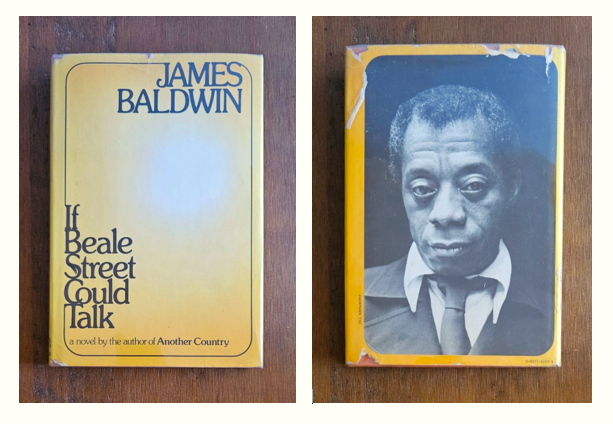
If Beale Street Could Talk

by James Baldwin

First Edition | The Dial Press | 1974

Buy Now!

James Baldwin’s fifth novel is, in many ways, emblematic of his work. A love story set amidst the racial injustices of midcentury America, If Beale Street Could Talk irrevocably intertwines suffering and passion, family and society, and how our human bonds shape our lives. 

This is the main thesis of much of Baldwin’s oeuvre. The main characters, Tish and Fonny, are engaged, pregnant, and trying their best to get by. But life, in the form of a false criminal accusation, derails their plans. Social and economic prejudices shape the accusation leading to Fonny’s arrest. 

Tish, the narrator (and Baldwin’s only female protagonist), struggles not only with Fonny’s arrest and all that entails, but with her pre-marital pregnancy. Religion, family, and social expectations both weaken and strengthen her familial bonds with both her and Fonny’s parents. Tish’s mother and Fonny’s father both go on journeys to try and save their children. In the end, Fonny is released from prison and Tish has their child, but the ending is neither a happy nor a sad one. Instead it is ambivalent and unsettled–a mirror of the world they live in. 

And as much as it is a romantic love story, If Beale Street Could Talk is also a familial love story. Extreme sacrifices are made for the love of Tish and Fonny. Their parents, with their own baggage and beliefs, clearly love their children and do their best to help them. The unity between all of them–symbolized by Tish and Fonny’s unborn child–tethers our characters together and ultimately allows them to get through their individual and combined struggles. 

In this way it is a very traditional love story. Its unconventionality lies in the social, economic, and racial commentary Baldwin so deftly weaves around his storytelling. Love, and life, cannot be separated from these outside sources. And it is this love that ultimately saves our characters from the psychological terrors of life, when others do not, or cannot, survive. Not exactly a high note to end on, but it is one of hope–that all the love in our own life, will also see us through.

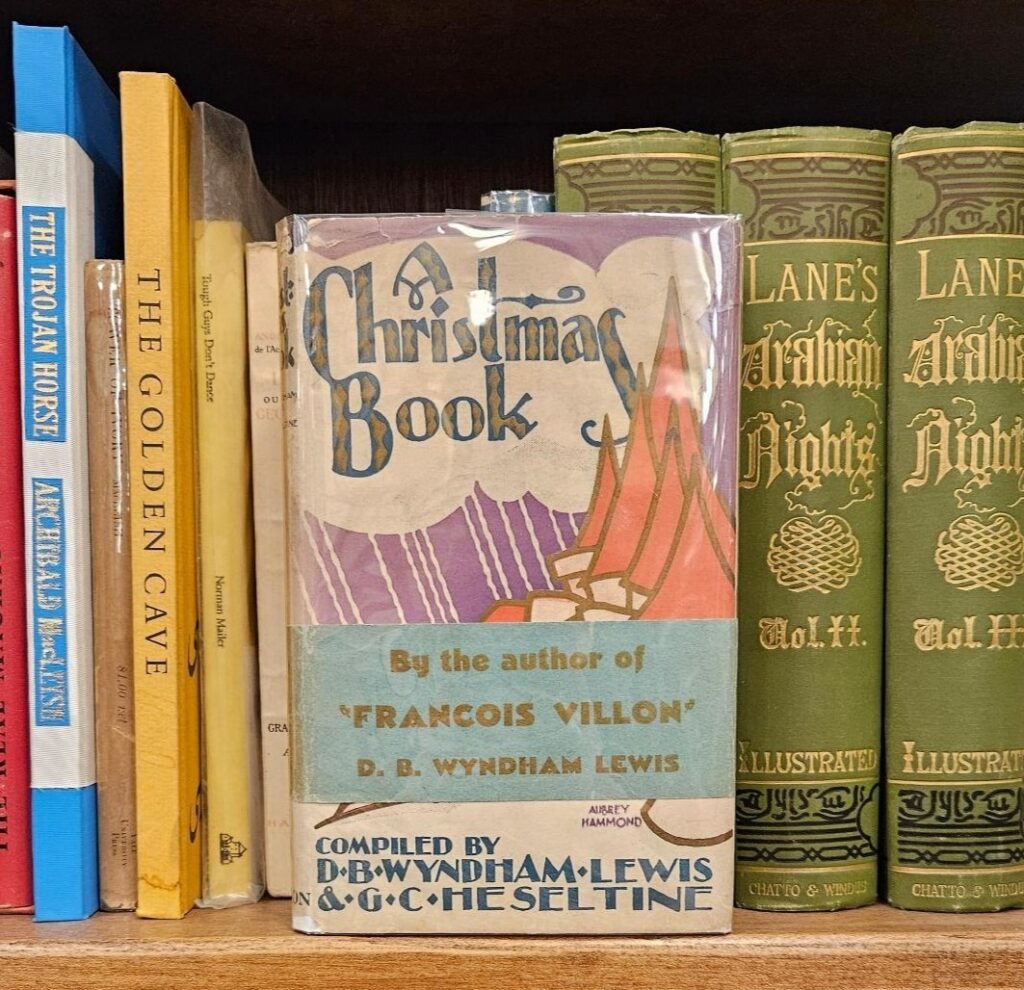
A Christmas Book: An Anthology for Moderns

by D. B. Wyndham Lewis and G. C. Heseltine

First Edition | J. M. Dent & Sons, Ltd. | 1928

Buy now!

Born Llewellyn Bevan Wyndham Lewis (1891-1969) but better known as Dominic, Wyndham Lewis originally intended to pursue a legal career. But WWI had other ideas. After his service with the Welch Regiment, Wyndham-Lewis turned instead to journalism, pursuing a career at the Daily Express. His work at the newspaper was primarily as a humorist. And under the pen name Beachcomber he wrote the “By the Way” column–which launched his literary career. Beachcomber was a pen name adopted from the column’s previous contributor and later passed on to his own successor, J. B. Morton.  

During the following years Wyndham-Lewis converted to Catholicism (changing his first name to Dominic, which all of his successive work is known by), took up the biography of French nobles, and produced a number of historical nonfiction. 

But Wyndham-Lewis is perhaps best known for being an editor and satirist. In fact, his comic sensibilities are on full display in The Stuffed Owl, an anthology of “bad verse” by well-known poets such as Edgar Allan Poe, William Wordsworth, and many others. 

It is this type of satirical work that is on full display in A Christmas Book: An Anthology for Moderns. In it, Wyndham Lewis maligns the modern world. It’s all a very tongue-in-cheek “kids these days” while also very seriously reminding his readers that not every poem, song, ballad, and recipe made it to the modern celebration of the holiday. The holiday traditions that we know and love–the Christmas stories that everyone knows and that get reprinted hundreds of times every year–are just the lucky few that were popular enough to make it through.

In fact, the preface very clearly states that “The following essentials to any Christmas Anthology will be found nowhere in this Anthology: extracts from Dickens, Pepys (with one exception), and (with one exception) Washington Irving, and reference (with one exception) to Father Christmas; also fake-Gothic carols (including Good King Wenceslas), robins, property Yule-logs, synthetic snow, redfaced jovial Squires, wigs by Clarkson, Ye Olde Englysshe Yuletyde Cheere (18—), and all manifestations of the coloured Christmas Supplement.”

And like any good satirist, Wyndham Lewis pretends to be a scrooge about who and what is included in his anthology…but also allows one or two exceptions. Because they’re classics and nostalgic and what’s the holiday season without a bit of fun?

This is a great book for any ultra-modern readers who have an interest in how the celebration of Christmas has evolved over the years–or who’d just like to spend a very merry afternoon reading holiday stories that you’ve likely never heard before. So pull up a chair, grab a hot beverage, and start your own modern reading tradition this Christmas. 

The Bachman Books: Four Early Novels by Stephen King

by Richard Bachman (aka Stephen King)

Book Club Edition | New American Library | 1985

Buy now!

Many authors write under pen names, for various reasons, but none may be as famously known as Richard Bachman–the king of horror himself, Stephen King.

Though he’d been writing professionally since 1967, King’s big break came with the publication of his first novel, Carrie, in 1974. It’s important to note the original hardcover edition of Carrie sold alright, but it was the paperback version, published in 1975, that eventually became the bestseller–with sales bolstered by the film adaptation in 1976. 

The success of Carrie established King as a new voice in horror fiction and allowed him to become a full time author. With nothing to impede him, King began to write prolifically, writing the drafts for his next two novels–Salem’s Lot and The Shining–within six months. 

Afraid to oversaturate the market with a single author, publishing houses only released one novel of an author’s per year. King, however, was already writing at a breakneck speed and curious if his success was due to skill or luck, decided to publish his fourth novel, Rage, under a pseudonym. 

The first four Bachman novels were originally released in paperback and with little fanfare, but over time fans quickly noticed many similarities between the authors’ writing. Some even accused Bachman of copying King’s style. It wasn’t until the release of Thinner (1984), the first hardcover Bachman novel, that the secret was revealed. 

Stephen P. Brown, a bookstore clerk and horror fiction aficionado, received an advanced reading copy of the novel and, noting the similarities in the style of both authors, became convinced they were one and the same man. In a real-time act of bibliography, he tracked down copyright documentation that proved King was Bachman. And so, on February 9, 1985, Richard Bachman died suddenly of “cancer of the pseudonym, a rare form of schizonomia.”

After the loss of Bachman’s anonymity, Thinner sales skyrocketed. In order to introduce King’s existing fanbase to his work under his penname, the first four Bachman books, Rage (1977), The Long Walk (1979), Roadwork (1981), and The Running Man (1982), were collected into a hardcover edition along with an introduction by King called, “Why I Was Bachman.”

And Bachman King remains, even to this day, as two more books have since been published under the penname–The Regulators (1996) and Blaze (2007). Affectionately called “trunk books” they claim to be found by the Bachman widow, Claudia, in a trunk or by King himself, in an attic among papers pre-dating Carrie

And so the story of Richard Bachman, worthy of its own twisting Stephen King novel, continues on, even after death.

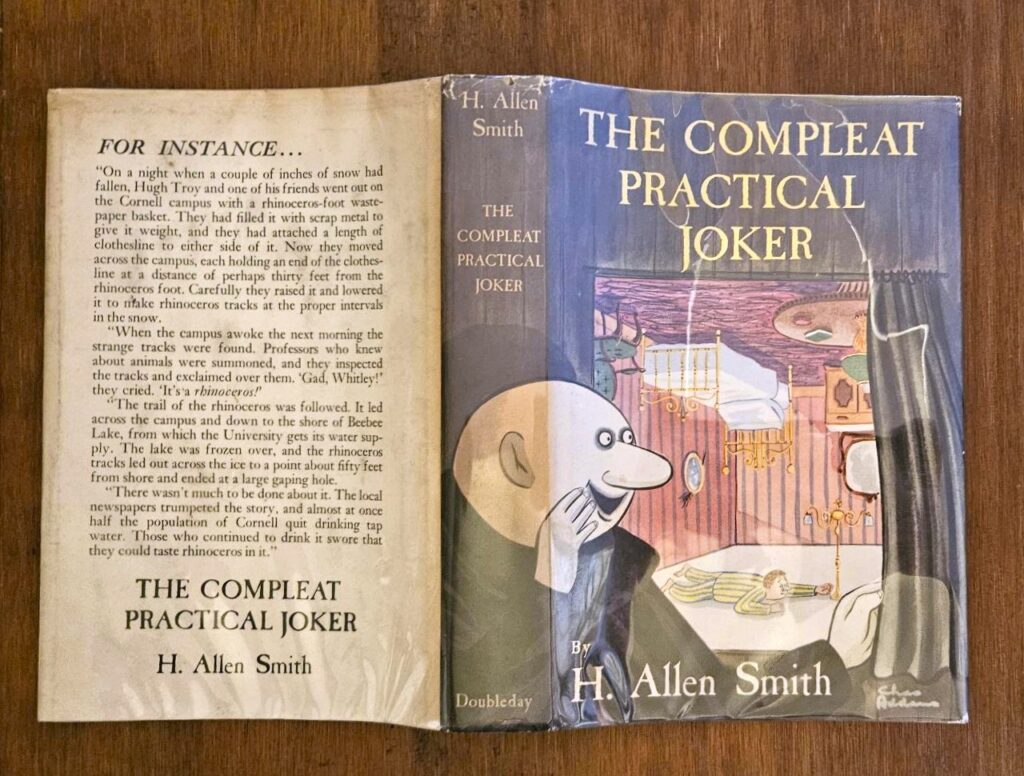
The Compleat Practical Joker

by H. Allen Smith and illustrated by Charles Addams

First Edition | Double Day & Company, Inc. | 1953

Buy now!

This post is only incidentally about the book The Compleat Practical Joker or its author, H. Allen Smith. Rather it’s about Charles Addams (1912-1988), who illustrated the dustjacket. 

Addams, as you may well know, was a cartoonist most famous for his Addams Family series about a spooky gothic family. But what isn’t as well known is that the members of the Addams Family–Gomez, Morticia, Pugsley, Wednesday, Grandmama, Uncle Fester, Lurch, Thing, and Cousin Itt–all existed as separate characters long before The Addams Family television show aired in 1964. 

In fact, the first published Addams Family cartoon was in The New Yorker in 1938. It’s a one-panel gag that features a then-unnamed Morticia and a proto-Lurch–who looks more like Boris Karloff than Frankenstein’s monster. Morticia is the earliest of the Addams Family characters to be introduced, later followed by Gomez, the children, and Fester. In 1946, we see these core members gathered together, possibly for the first time, celebrating the holidays by scalding Christmas carolers with boiling oil. 

Which is why it’s not very unusual to see Uncle Fester peeking around the corner of The Compleat Practical Joker’s (1958) dustjacket, even though it is almost a decade before the airing of the television show. Addams often reused his favorite characters and Fester, being the most like Charles Addams himself, is the perfect character to illustrate a book on practical jokes. After all, Addams was a satirist, cartoonist, and humorist. Fester lights up the topsy-turvy room. 

The Addams Family television show only lasted two seasons, but Charles’ unique gothic sensibility has stood the test of time–with the 90s movies, the Hanna-Barbera cartoon, the modern Netflix series, and even a musical–helping to ensure that Charles Addams’ art and legacy haunts us to this day. 

They’re creepy and they’re kooky
Mysterious and spooky
They’re all together ooky
The Addams family


“The Addams Family Theme”
by Andrew Gold

Battling the Wind; Or, Ted Scott Flying Around Cape Horn

by Franklin W. Dixon (John W. Duffield)

First Edition | Grosset & Dunlap | 1933

Buy now!

When the Orville Brothers first set flight in 1903, the world of literature also took flight along with them. Especially in the realm of juvenile literature. But it was Charles Lindbergh’s solo flight that really propelled the genre of aviation stories into the book zeitgeist. 

Boys’ Series, as they are now colloquially called, were primarily the invention of Edward Stratemeyer, whose Stratemeyer Syndicate reshaped juvenile fiction during the first half of the 20th century. Making use of an army of ghostwriters, the Syndicate pumped out many popular series that are still beloved today–Nancy Drew, the Hardy Boys, Tom Swift, the Bobbsey Twins, and, of course, Ted Scott. Many of the most enduring series were detective stories, but as Ted Scott shows, the aviation craze sparked by Lindbergh’s transatlantic flight, was a sub-genre that took off in 1927. 

Based on the persona of Lindbergh fed to the American public, Ted Scott was depicted as an ideal of youthful masculinity. Quietly patriotic, modest of his achievements, but always pursuing knowledge, Ted was meant to inspire young boys to enter science, engineering, and aviation fields. 

In fact, John Duffield–the actual “Franklin W. Dixon–was himself an aviation buff. And the books were littered with the lingo of flight, and in the fashion of Moby-Dick, included asides on the science of aviation. In fact, actual passages from Aviation, the New York Times, Aero Digest, and Science were included in the books, copyright notwithstanding. 

Many of Ted’s adventures were lifted straight from headlines or echoed Lindbergh’s own achievements. The very first book of the series, Over the Ocean to Paris, sets this tone and it is kept up through all twenty volumes of the Ted Scott Flying Series. Ted *is* Lindy–but less myth and more man. A hero for young boys that they could relate to and aspire to be. 

But also a hero they could touch, literally hold in their hands. The books were modest, as all Stratemeyer books were–meant to be affordable to their young readership–but also beautiful. Hardbound, stamped with images on the covers, pictorial endpapers, internal illustrations, and, perhaps most importantly, evocative and bright dustjackets that depicted the worlds of each series. And in the case of Ted Scott, that world was the soaring imagination of the sky. 

Star Trek: Logs One–Ten

by Alan Dean Foster

SIGNED | First Editions | Ballantine and Del Rey | 1974-1978

Buy now!

The Star Trek: Log books are the complete novelization of all 22 episodes of Star Trek: The Animated Series (colloquially referred to as TAS by fans). It is the first English-language TV series to be completely adapted into literary form. All ten books are signed by Alan Dean Foster. 

The Logs have a really unusual publishing history. Which, as both a book nerd and a Trekkie, I find really interesting. Published from 1974-1978, the first six paperbacks each contain three novella-length episode adaptations, which were written as linked stories. The final four books were adaptations of individual episodes that contained original components and extended plots. So the end result is a series that contains a mix of straightforward recaps and original storytelling. 

To make things even more interesting, the original publisher, Ballantine Books, began the print run using Filmation cells from the show as the cover artwork. With white wraps and colorful text, the animation stills clearly delineated the books as TAS stories. However, sometime in 1976, a decision was made to change the book design. So Logs Nine and Ten feature starship artwork by Stanislaw Fernandes, who had recently moved from Corgi Books the UK–where, as Art Director, he mostly likely signed off on the designs for the UK editions of Logs One through Five (the deal to reprint Logs Six through Ten fell through, so the UK editions aren’t a complete set). 

To add a further complication to matters, Ballantine shifted the Star Trek Logs to their newly created imprint, Del Rey, in 1977. So the colophon and trim size varies slightly in Log Ten, compared to the previous volumes. 

In the present day realm of book collecting, this results in a very unique outcome–you cannot get a full matching set of first edition Logs. They just don’t exist. A full matching set of Fernandes cover designs are available. Later Del Rey editions were redesigned with his starship artwork on brightly colored, solid backgrounds, resulting in a psuedo-rainbow effect when the volumes are lined up on a shelf. And though the background colors have occasionally changed over the years, (somewhat marring the flow from one color to another) the starship designs have not. They remain a matching set. 

And maybe you’re asking yourself. Why is any of this important? What’s so interesting about first edition book designs that don’t match?

And I suppose the answer is it’s a really good story. And kinda familiar–the Logs are the first books of their kind to be a complete television novelization, but it’s a bit hodge-podge in makeup and the covers don’t quite match. And yet, like a certain crew, they belong together. So as one enterprising first officer might say, “Fascinating, Captain.”