A Night in the Lonesome October

by Roger Zelazny

SIGNED | Limited Edition | Easton Press | 1993

Buy now!


“To — — –. Ulalume: A Ballad”

The skies they were ashen and sober;
      The leaves they were crispéd and sere—
      The leaves they were withering and sere;
It was night in the lonesome October
      Of my most immemorial year;


by Edgar Allan Poe

A Night in the Lonesome October is perhaps the best Halloween story you can read. Written by the late, great Roger Zelazny–himself a literary titan–the characters and settings are heavily borrowed from the great names of gothic, horror, mystery, and science fiction. Jack the Ripper, Sherlock Holmes, Dr. Frankenstein, Dracula, the Wolf Man, and the Elder Gods of the Cthulhu mythos all make appearances.

The story itself is broken into 32 chapters. One for every day of October, plus an introductory chapter that introduces our protagonist, Snuff the Watchdog. The entire story is told through his eyes. And though the story revolves around the motives of the literary characters–the action takes place with Snuff and the menagerie of animal familiars Bubo the rat, to name a few.

Without spoiling too much of the plot–since discovering how events unfold along with our characters is part of the delight in reading this story–the basic premise is that the rare blue moon on Halloween night will open a hellmouth between worlds. And what that means for Snuff, his master, and the many inhabitants of the strange community they have formed together.

In fact, it’s become somewhat of a tradition for Zelazny fans to re-read the story every year–one chapter a day over the course of October. Repeatedly coming back to it and trying to parse out all the very many literary and cinematic references he wrote in. And I’ll admit, I have a whole document of my own outlining my own thoughts as I read the story. I felt much like a literary Sherlock Holmes of my own, which added to the experience tremendously. 

The beautiful Easton Press edition of this story is bound in blood-red leather, adorned in gilt, and illustrated by Gahan Wilson. It’s also signed by Zelazny–and considering he passed only a few short years after the publication of this story–that makes it a treasure beyond imagination. A collectible edition you can pull out every Halloween until time immemorial.
Star Trek: Logs One–Ten

by Alan Dean Foster

SIGNED | First Editions | Ballantine and Del Rey | 1974-1978

Buy now!

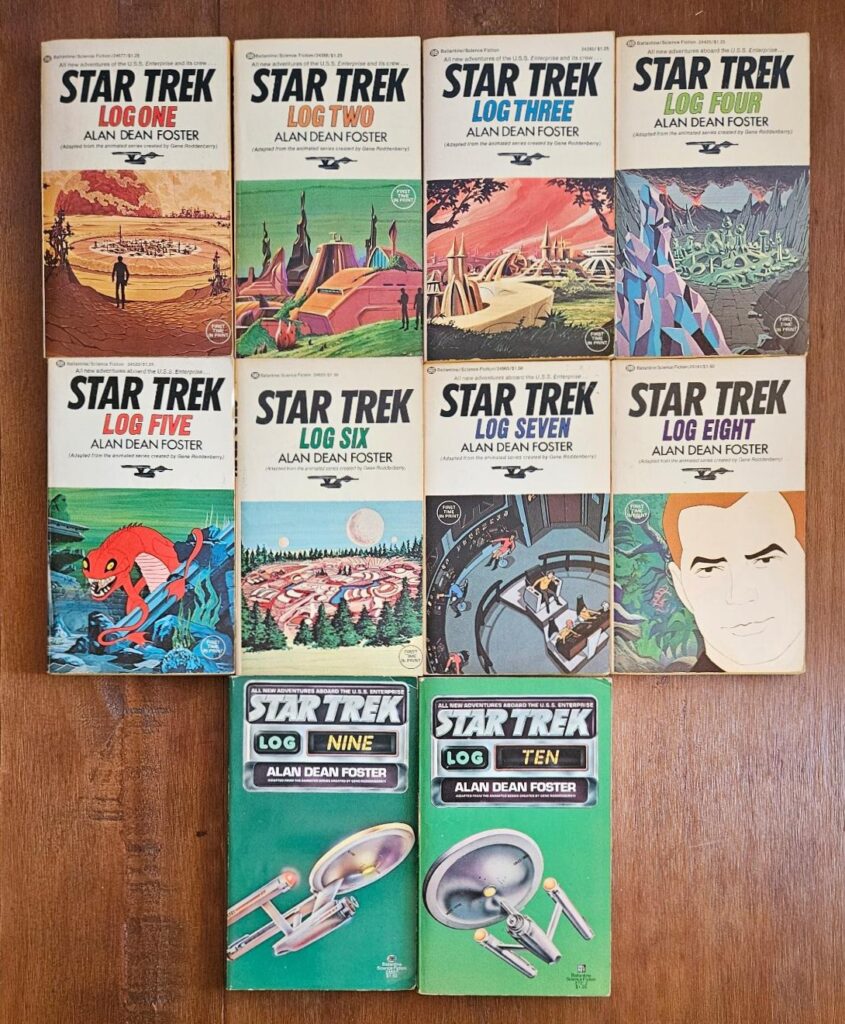
The Star Trek: Log books are the complete novelization of all 22 episodes of Star Trek: The Animated Series (colloquially referred to as TAS by fans). It is the first English-language TV series to be completely adapted into literary form. All ten books are signed by Alan Dean Foster. 

The Logs have a really unusual publishing history. Which, as both a book nerd and a Trekkie, I find really interesting. Published from 1974-1978, the first six paperbacks each contain three novella-length episode adaptations, which were written as linked stories. The final four books were adaptations of individual episodes that contained original components and extended plots. So the end result is a series that contains a mix of straightforward recaps and original storytelling. 

To make things even more interesting, the original publisher, Ballantine Books, began the print run using Filmation cells from the show as the cover artwork. With white wraps and colorful text, the animation stills clearly delineated the books as TAS stories. However, sometime in 1976, a decision was made to change the book design. So Logs Nine and Ten feature starship artwork by Stanislaw Fernandes, who had recently moved from Corgi Books the UK–where, as Art Director, he mostly likely signed off on the designs for the UK editions of Logs One through Five (the deal to reprint Logs Six through Ten fell through, so the UK editions aren’t a complete set). 

To add a further complication to matters, Ballantine shifted the Star Trek Logs to their newly created imprint, Del Rey, in 1977. So the colophon and trim size varies slightly in Log Ten, compared to the previous volumes. 

In the present day realm of book collecting, this results in a very unique outcome–you cannot get a full matching set of first edition Logs. They just don’t exist. A full matching set of Fernandes cover designs are available. Later Del Rey editions were redesigned with his starship artwork on brightly colored, solid backgrounds, resulting in a psuedo-rainbow effect when the volumes are lined up on a shelf. And though the background colors have occasionally changed over the years, (somewhat marring the flow from one color to another) the starship designs have not. They remain a matching set. 

And maybe you’re asking yourself. Why is any of this important? What’s so interesting about first edition book designs that don’t match?

And I suppose the answer is it’s a really good story. And kinda familiar–the Logs are the first books of their kind to be a complete television novelization, but it’s a bit hodge-podge in makeup and the covers don’t quite match. And yet, like a certain crew, they belong together. So as one enterprising first officer might say, “Fascinating, Captain.” 

The Unpleasant Profession of Jonathan Hoag

by Robert A. Heinlein

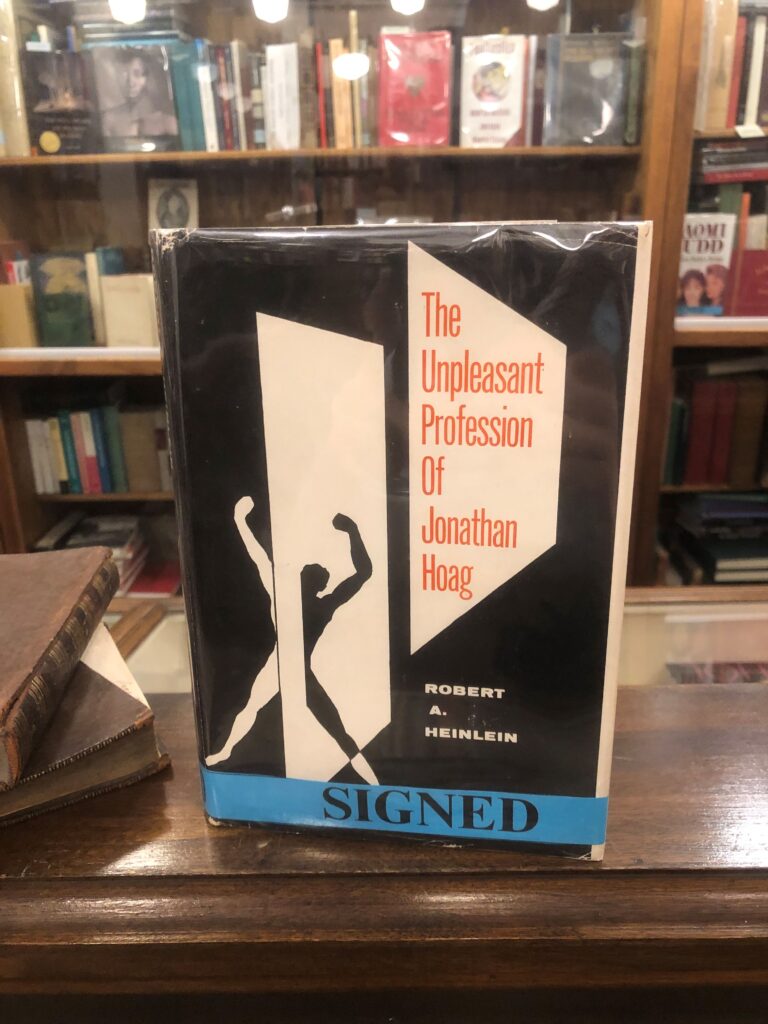
First Edition | SIGNED | Gnome Press | 1959

Call, email, or visit us in the store to buy this book!

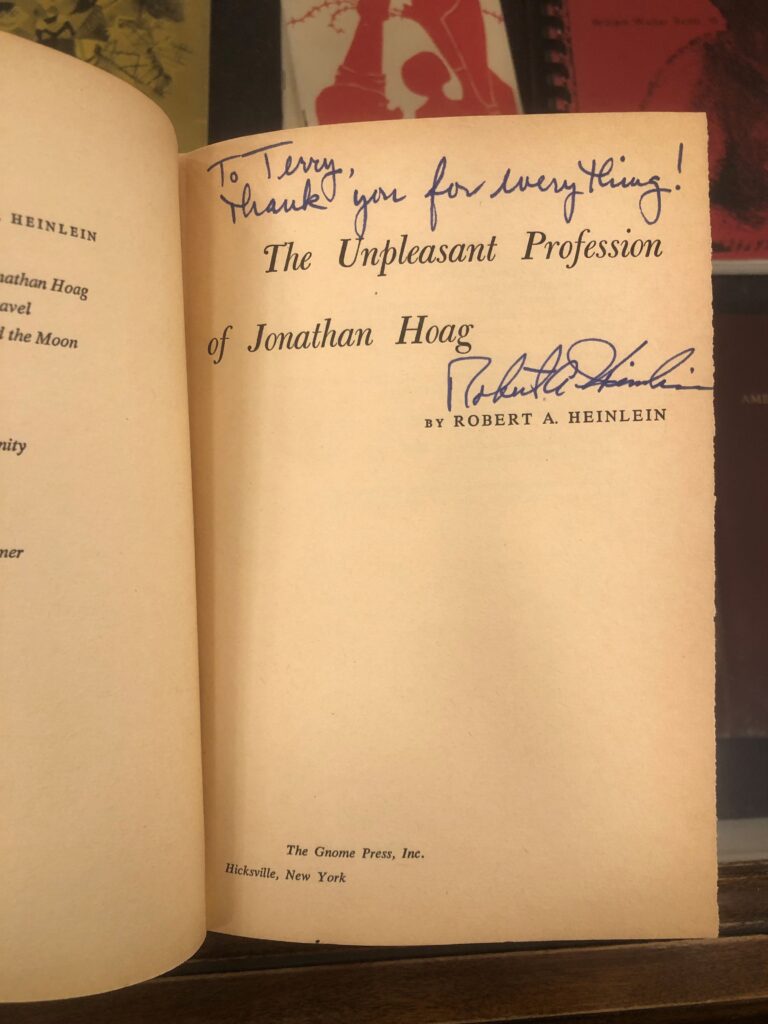
In conversations about science fiction greats, Heinlein’s name looms large. His rise to popularity coincided with the genre’s, which first gained readership through pulp magazines such as Astounding Science Fiction (originally Astounding Stories, now known as Analog), which published Heinlein’s early stories alongside the likes of Isaac Asimov. Astounding‘s sister magazine, Unknown Worlds, originally published the novella The Unpleasant Profession of Jonathan Hoag, which was then re-published in book form alongside five other Heinlein stories. This is the version you see here — a first edition, signed by Heinlein and published by Gnome Press.

Gnome Press, like Heinlein and Astounding, played a foundational role in building the science fiction genre as it is known today. In the 1940s, sci-fi was largely published in magazines; Gnome’s founders, Martin L. Greenberg and David Kyle, dreamed of building a mass market for sci-fi books. And they succeeded! Beginning in 1948, Gnome published more than fifty books, including, perhaps most notably, Isaac Asimov’s Foundation Trilogy. In addition to publishing novels, they gathered stories previously seen in magazines into one place, as was the case with Jonathan Hoag. Soon mainstream publishers began to take notice of the press’s success, and the genre flourished in the way Greenberg and Kyle hoped it would. Ultimately, Gnome’s progress was its downfall. The press couldn’t keep up with the financial pressure and folded in 1962.

Heinlein published four books with Gnome Press: Sixth Column, Methuselah’s Children, The Menace From Earth, and The Unpleasant Profession of Jonathan Hoag. He was one of the leading writers of “hard” science fiction, which emphasized scientific accuracy, though Jonathan Hoag deviates from this categorization with its uncharacteristic elements of fantasy and mystery. In his life, Heinlein authored over thirty books, twice as many stories, and sixteen collections. In recognition of his achievements, the Science Fiction and Fantasy Writers Association named Heinlein the first Science Fiction Grand Master in 1974. The master himself has made his mark on our copy of Jonathan Hoag with an inscription that reads: “To Terry, Thank you for everything!”

With its ties to Heinlein, Gnome Press, and Astounding, this book is a piece of sci-fi history. Come by The Dawn Treader today to see Heinlein’s gratitude for yourself.