
Battling the Wind; Or, Ted Scott Flying Around Cape Horn

by Franklin W. Dixon (John W. Duffield)

First Edition | Grosset & Dunlap | 1933

Buy now!

When the Orville Brothers first set flight in 1903, the world of literature also took flight along with them. Especially in the realm of juvenile literature. But it was Charles Lindbergh’s solo flight that really propelled the genre of aviation stories into the book zeitgeist. 

Boys’ Series, as they are now colloquially called, were primarily the invention of Edward Stratemeyer, whose Stratemeyer Syndicate reshaped juvenile fiction during the first half of the 20th century. Making use of an army of ghostwriters, the Syndicate pumped out many popular series that are still beloved today–Nancy Drew, the Hardy Boys, Tom Swift, the Bobbsey Twins, and, of course, Ted Scott. Many of the most enduring series were detective stories, but as Ted Scott shows, the aviation craze sparked by Lindbergh’s transatlantic flight, was a sub-genre that took off in 1927. 

Based on the persona of Lindbergh fed to the American public, Ted Scott was depicted as an ideal of youthful masculinity. Quietly patriotic, modest of his achievements, but always pursuing knowledge, Ted was meant to inspire young boys to enter science, engineering, and aviation fields. 

In fact, John Duffield–the actual “Franklin W. Dixon–was himself an aviation buff. And the books were littered with the lingo of flight, and in the fashion of Moby-Dick, included asides on the science of aviation. In fact, actual passages from Aviation, the New York Times, Aero Digest, and Science were included in the books, copyright notwithstanding. 

Many of Ted’s adventures were lifted straight from headlines or echoed Lindbergh’s own achievements. The very first book of the series, Over the Ocean to Paris, sets this tone and it is kept up through all twenty volumes of the Ted Scott Flying Series. Ted *is* Lindy–but less myth and more man. A hero for young boys that they could relate to and aspire to be. 

But also a hero they could touch, literally hold in their hands. The books were modest, as all Stratemeyer books were–meant to be affordable to their young readership–but also beautiful. Hardbound, stamped with images on the covers, pictorial endpapers, internal illustrations, and, perhaps most importantly, evocative and bright dustjackets that depicted the worlds of each series. And in the case of Ted Scott, that world was the soaring imagination of the sky. 
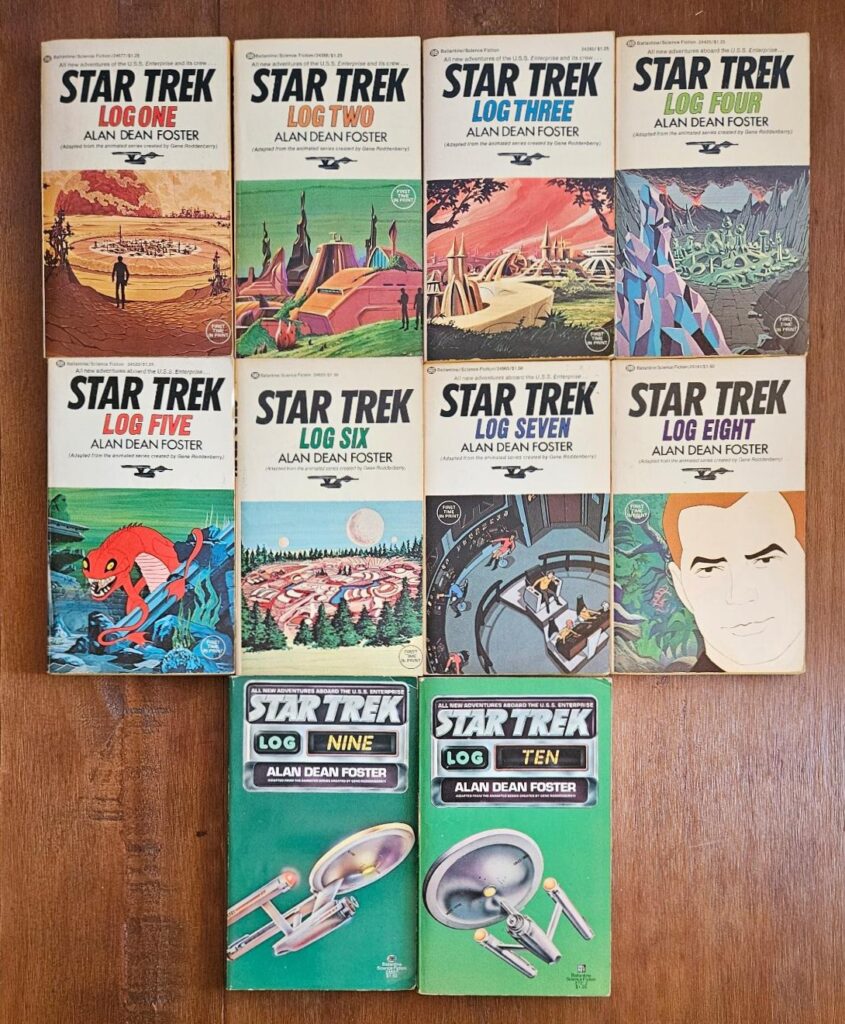
Star Trek: Logs One–Ten

by Alan Dean Foster

SIGNED | First Editions | Ballantine and Del Rey | 1974-1978

Buy now!

The Star Trek: Log books are the complete novelization of all 22 episodes of Star Trek: The Animated Series (colloquially referred to as TAS by fans). It is the first English-language TV series to be completely adapted into literary form. All ten books are signed by Alan Dean Foster. 

The Logs have a really unusual publishing history. Which, as both a book nerd and a Trekkie, I find really interesting. Published from 1974-1978, the first six paperbacks each contain three novella-length episode adaptations, which were written as linked stories. The final four books were adaptations of individual episodes that contained original components and extended plots. So the end result is a series that contains a mix of straightforward recaps and original storytelling. 

To make things even more interesting, the original publisher, Ballantine Books, began the print run using Filmation cells from the show as the cover artwork. With white wraps and colorful text, the animation stills clearly delineated the books as TAS stories. However, sometime in 1976, a decision was made to change the book design. So Logs Nine and Ten feature starship artwork by Stanislaw Fernandes, who had recently moved from Corgi Books the UK–where, as Art Director, he mostly likely signed off on the designs for the UK editions of Logs One through Five (the deal to reprint Logs Six through Ten fell through, so the UK editions aren’t a complete set). 

To add a further complication to matters, Ballantine shifted the Star Trek Logs to their newly created imprint, Del Rey, in 1977. So the colophon and trim size varies slightly in Log Ten, compared to the previous volumes. 

In the present day realm of book collecting, this results in a very unique outcome–you cannot get a full matching set of first edition Logs. They just don’t exist. A full matching set of Fernandes cover designs are available. Later Del Rey editions were redesigned with his starship artwork on brightly colored, solid backgrounds, resulting in a psuedo-rainbow effect when the volumes are lined up on a shelf. And though the background colors have occasionally changed over the years, (somewhat marring the flow from one color to another) the starship designs have not. They remain a matching set. 

And maybe you’re asking yourself. Why is any of this important? What’s so interesting about first edition book designs that don’t match?

And I suppose the answer is it’s a really good story. And kinda familiar–the Logs are the first books of their kind to be a complete television novelization, but it’s a bit hodge-podge in makeup and the covers don’t quite match. And yet, like a certain crew, they belong together. So as one enterprising first officer might say, “Fascinating, Captain.”