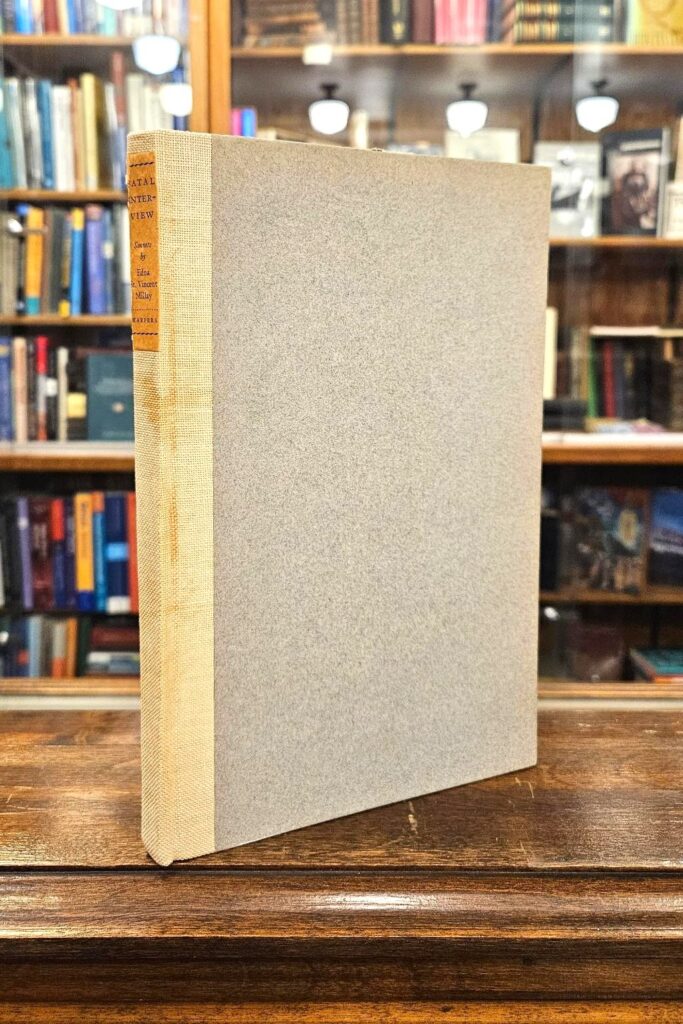
by Edna St. Vincent Millay
SIGNED | First Edition | Harper and Brothers Publishers | 1931
Edna St Vincent Millay, who went by Vincent throughout her life, was a fascinating woman living right at the turn of the nineteenth century. Raised, along with her two sisters, by her single mother, Vincent was encouraged to be self-aware, highly creative, and ambitious.
Her writing career started at a young age, winning a poetry prize at 14 and published by 15. By 21 she was attending Vassar College on a full scholarship. School was difficult for Millay, who was used to a high degree of independence that the institution didn’t offer. She was a juxtaposition of the jazz age woman–often smoking, gambling, drinking, and flirting with both men and women; while also maintaining a strict, self-imposed writing schedule that won her both high honors in the literary circles and kept her mother and sisters out of poverty.
After her graduation, Vincent moved to Greenwich Village–the beating heart of the bohemian jazz age. Often starring in theater productions and reading tours, Vincent was both widely popular and highly controversial. Her poetry over the years dealt with such taboo themes as feminism, divorce, war, and poverty. And yet, her vivacity and intelligence inevitably won people over.
In 1923, at the age of 31, Vincent won the Pulitzer Prize for “The Ballad of the Harp-Weaver.” Though the Pulitzer Prizes had been around for six years, this was only the second year the Poetry Award had been established.
During the next few years Vincent married Eugen Jan Boissevain and moved into her own home, Steepletop, near Austerlitz, New York. Once a blueberry farm, it became Vincent’s writing and entertaining retreat. After her death, her sister, Norma helped establish Steepletop as a writer’s colony, attended by such famous poets as Mary Oliver. After Norma’s passing, a land sale helped preserve Steepletop as a museum.
Fatal Interview is Vincent’s seventh book of poetry. Published in 1931 when Vincent was 39 years old, the sonnets mourn a failed love affair. Though devotedly married and semi-retired at Steepletop, Vincent still led a very unconventional and bohemian life that included a number of lovers, a possible gambling problem, and a drug addiction from a traumatic car crash years before.
Reading Vincent’s poetry is to take a peek into that life and feel, for just a moment, like you too are a young jazz age debutante, a vibrant performer, a social activist, an eclectic poet all rolled into one.