

by Isaac Asimov
First Edition | Simon and Schuster | 1952
Buy in shop!
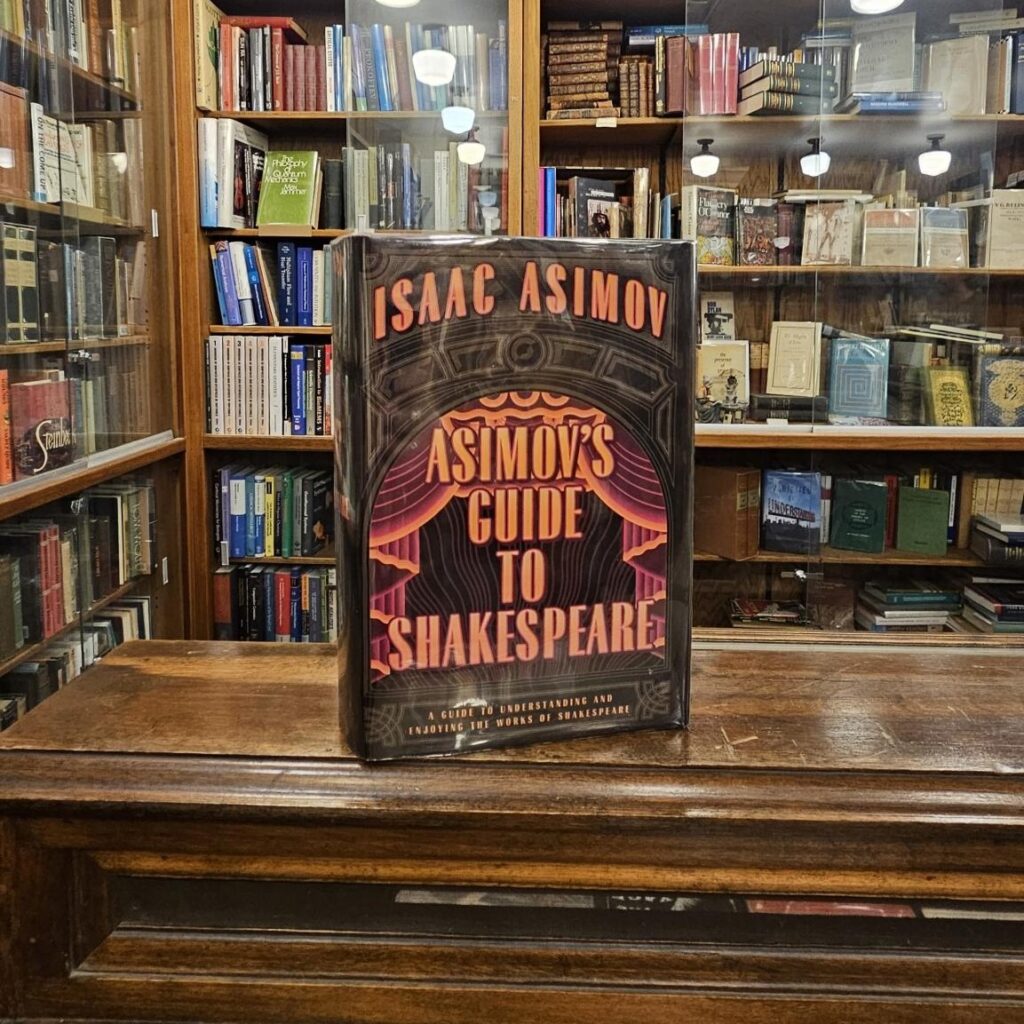
A little known work of prolific sci-fi author Isaac Asimov is his Guide to Shakespeare, a compendium of William Shakespeare’s plays, including maps and an index. Originally written as a companion to the New American Library “Signet Classic Shakespeare” that Asimov himself owned, the Guide was never meant to be a work of literary criticism, Rather it was conceived to explain the background of all 38 plays and two narrative poems.
Since Shakespreare was alive and writing during Elizabethan England, when a Classical education was the bedrock of scholarship, many of the events described within the plays are beyond the scope of an average midcentury American education. And so Asimov has taken it upon himself to provide us with that historical, legendary, and mythological background.
Unlike other Shakespeare scholars, Asimov organizes the plays regionally, rather than by the traditional method of grouping the comedies, then the histories, and finally the tragedies together. Asimov eschews this practice, as it removes them from any chronological order. He also makes it clear that he does not intend chronological to mean publication order–since we do not know when many of the plays were first being written, but also because that removes a lot of continuity from the plays themselves. Rather, he’d like the plays to be chronological based on the events that happen within them.
Hence his “geographical” sorting. Those he labels Greek plays have their basis in Greek legend, mythology, or history. The same goes for Roman. Even the plays that he considered Greek or Roman “historical fiction” get sorted into these categories.
The Italian plays are those in an Italian Renaissance setting–or in nearby France, Austria, or Illyria, but unpinned to time. The English plays are essentially all histories, legendary or not, of the United Kingdom–controversially including both Hamlet and Macbeth.
This method of sorting is not an exact chronological order for the Shakespeare plays. Many of the timelines of the latter Greek plays overlap with those of early Roman plays. As do some of the latter Roman plays with the early English plays. But by breaking them down by region, Asimov attempts to make the plays more accessible to the laymen reading public.
It is an unconventional method, but Asimov does succeed in shedding light onto the nature of the plays and the information that they contain within. His Guide makes for a fascinating read, with or without the plays they are attached to.