
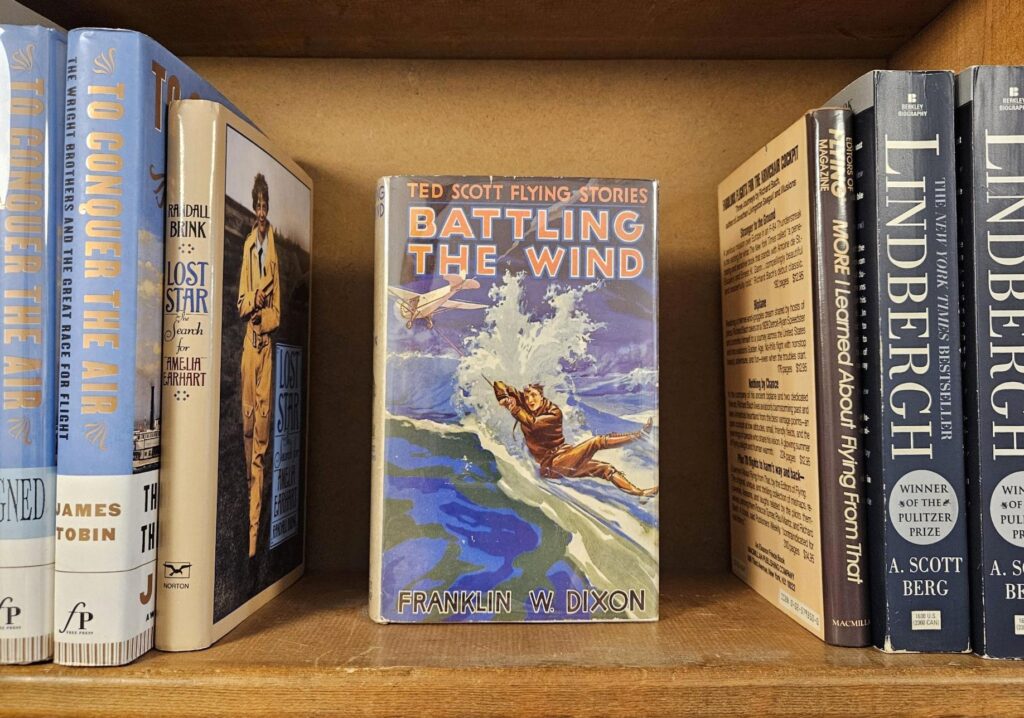
by Franklin W. Dixon (John W. Duffield)
First Edition | Grosset & Dunlap | 1933
Buy now!
When the Orville Brothers first set flight in 1903, the world of literature also took flight along with them. Especially in the realm of juvenile literature. But it was Charles Lindbergh’s solo flight that really propelled the genre of aviation stories into the book zeitgeist.
Boys’ Series, as they are now colloquially called, were primarily the invention of Edward Stratemeyer, whose Stratemeyer Syndicate reshaped juvenile fiction during the first half of the 20th century. Making use of an army of ghostwriters, the Syndicate pumped out many popular series that are still beloved today–Nancy Drew, the Hardy Boys, Tom Swift, the Bobbsey Twins, and, of course, Ted Scott. Many of the most enduring series were detective stories, but as Ted Scott shows, the aviation craze sparked by Lindbergh’s transatlantic flight, was a sub-genre that took off in 1927.
Based on the persona of Lindbergh fed to the American public, Ted Scott was depicted as an ideal of youthful masculinity. Quietly patriotic, modest of his achievements, but always pursuing knowledge, Ted was meant to inspire young boys to enter science, engineering, and aviation fields.
In fact, John Duffield–the actual “Franklin W. Dixon–was himself an aviation buff. And the books were littered with the lingo of flight, and in the fashion of Moby-Dick, included asides on the science of aviation. In fact, actual passages from Aviation, the New York Times, Aero Digest, and Science were included in the books, copyright notwithstanding.
Many of Ted’s adventures were lifted straight from headlines or echoed Lindbergh’s own achievements. The very first book of the series, Over the Ocean to Paris, sets this tone and it is kept up through all twenty volumes of the Ted Scott Flying Series. Ted *is* Lindy–but less myth and more man. A hero for young boys that they could relate to and aspire to be.
But also a hero they could touch, literally hold in their hands. The books were modest, as all Stratemeyer books were–meant to be affordable to their young readership–but also beautiful. Hardbound, stamped with images on the covers, pictorial endpapers, internal illustrations, and, perhaps most importantly, evocative and bright dustjackets that depicted the worlds of each series. And in the case of Ted Scott, that world was the soaring imagination of the sky.