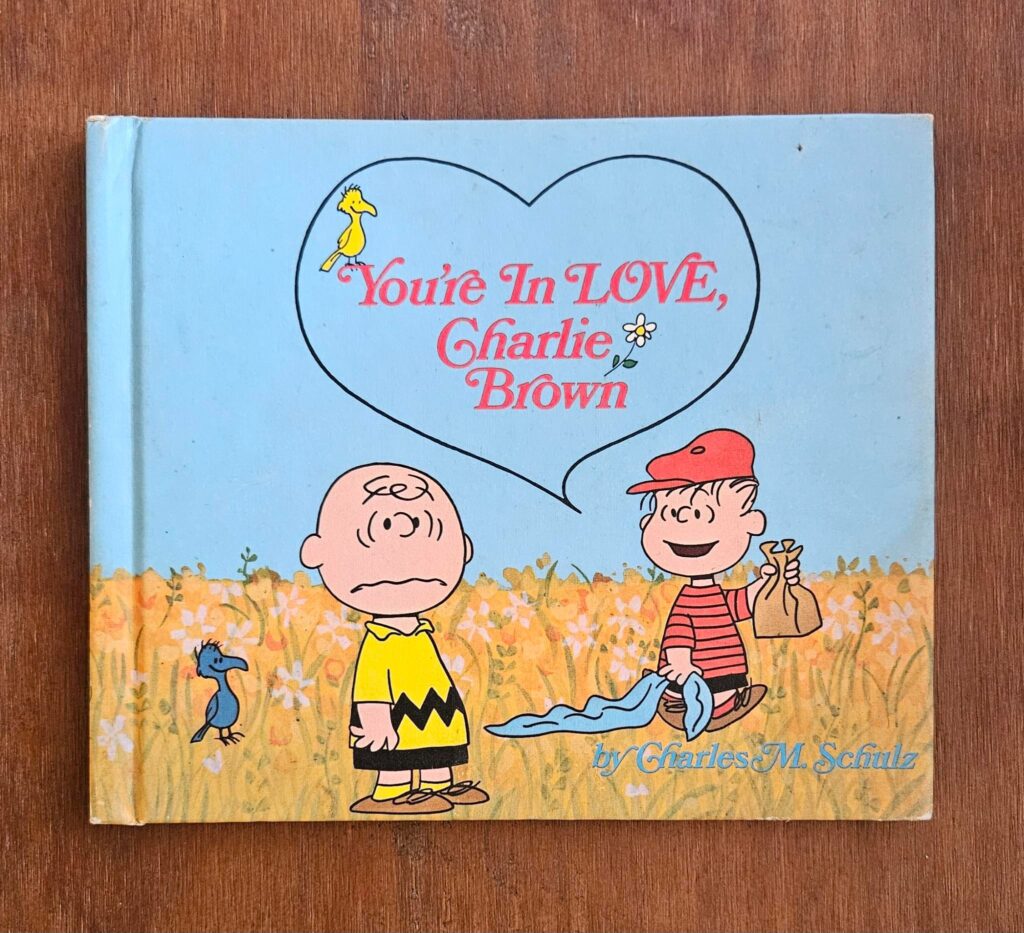
You’re in Love, Charlie Brown

by Charles M. Schultz

First Edition | The World Publishing Company | 1968

SOLD!

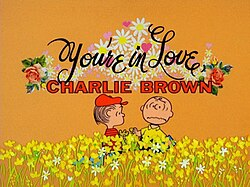
This book is the “novelization” of the prime-time animated TV special, “You’re in Love, Charlie Brown” that aired on June 16th, 1967. Based on the Peanuts comic strip that ran from 1950-2000 by Charles M. Schultz. 

Our beloved anti-hero Charlie Brown is having an existential crisis over his crush on “the pretty little red-haired girl.” He wants to meet her, be friends, maybe have lunch together. But as he fumbles through the last couple days of school, his mind on impressing his classmate, we (as the audience) quickly see that Charlie is at no loss for friends. 

Linus walks to school with Charlie as well as sits with him at lunch, though Charlie’s too busy fretting to notice. Peppermint Patty calls him up (her first appearance in the franchise) to invite him to play baseball over the summer. She even affectionately calls him “Chuck” and offers to help him try and meet the Little Red-Haired Girl. 

Lucy is the most antagonistic, teasing him about his crush, but that has more to do with her own melodramatic, soap-opera adjacent fantasies of a life with Schroeder, than anything to do with Charlie himself. And it is also the kind of underlyingly fond 8-year-old teasing that comes from being close friends and neighbors. 

The point is that Charlie does have a group of friends. He is not alone. The Little Red-Haired Girl, though obviously a real person in the Charlie Brown universe, is never shown in-person or referred to by her given name. And that’s because she’s actually a metaphor. A projection of Charlie’s own insecurities about his place in his community and how he will fit, now that summer is arriving and school will be out. 

But as we have already seen, that problem is solved by Peppermint Patty’s arrival and invitation to play baseball. And he already had his sister Sally, his dog Snoopy, and his best friend Linus–they would not have disappeared over the summer break.

What Charlie really needed to find was his own confidence. So when a note signed “The Little Red-Haired Girl” mysteriously finds its way into his hand as the final busses depart the schoolyard, Charlie is elated. He was noticed! Even if, I suspect, it was by Linus or Lucy or Peppermint Patty slipping him the note. It doesn’t matter, the result is the same, Charlie runs home feeling on top of the world. And we do too, because *we* love you, Charlie Brown.

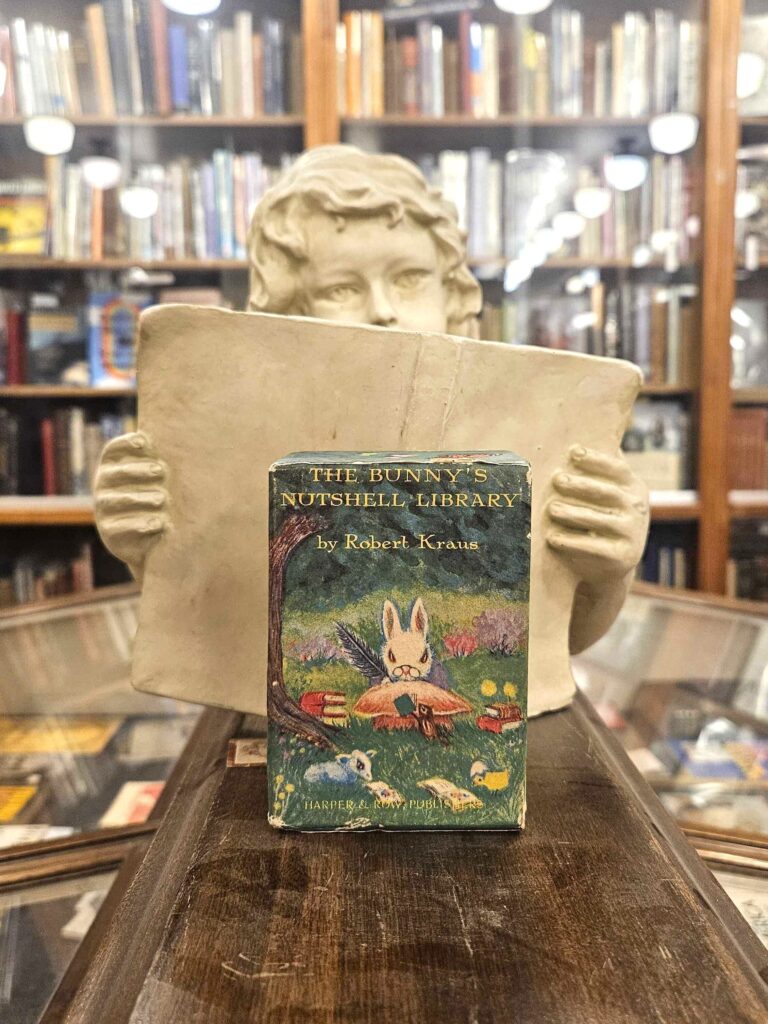
The Bunny’s Nutshell Library

by Robert Kraus

First Edition | Harper & Row | 1965

Update: This book has been sold!

Robert Kraus did not begin his career in the realm of children’s literature. Though he did start as a child himself. At age ten he won a local cartoon contest, by 12 he was employed at the Milwaukee Journal, and by 16 he was working for The New Yorker. So maybe it’s no surprise that, after spending 15 years with the magazine, Kraus pivoted his career and founded a small publishing house, Windmill Books, in 1965 (eventually purchased by Simon & Schuster in the 1980s) and turned his eye to the whimsical world of children’s literature. 

Gone were the portraits of gritty New York City and its denizens, replaced with rabbits and easter egg houses. With a penchant for anthropomorphic animals and life lessons, Kraus’ oeuvre of children’s stories evokes The Tale of Peter Rabbit, The Hundred Acre Woods, The Wind in the Willows, and Frog & Toad. Small stories for small people (and animals!) that are well known to this day. 

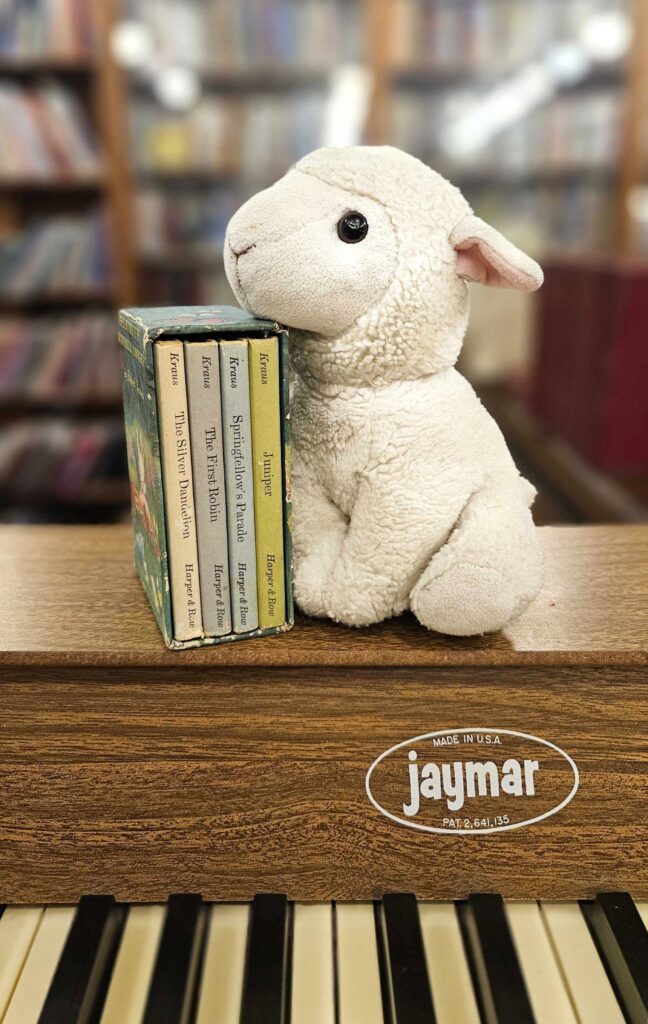
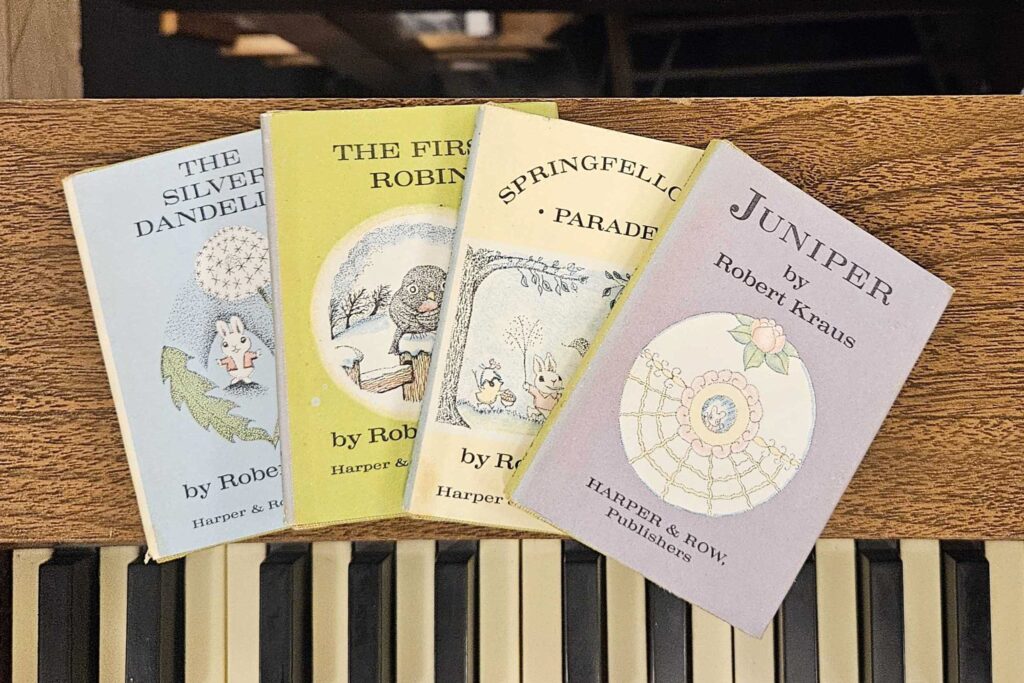
But of all his works, perhaps none was so charming as The Bunny’s Nutshell Library, which he wrote and illustrated. One of three Nutshell Library collections published by Harper & Row in the 1960s–Maurice Sendak’s Nutshell Library in 1962, Hilary Knight’s Christmas Nutshell Library in 1963, and, finally, Robert Kraus’ The Bunny’s Nutshell Library in 1965–Kraus’ Nutshell Library consists of: The Silver Dandelion, The First Robin, Springfellow’s Parade, and Juniper, gentle stories about bullying, being accepted, loneliness, and friendship. 

The four charming tales in his collection, paired with their cozy illustrations, reflect that same childhood nostalgia that lives in all of us. When the world was very, very small and so were we–but our imaginations were oh so big.